


By: Delta Staff
Your impact lands differently than you think
A senior leader gives clear instructions to a distributed team. She follows up with an email summary. She checks the box on communication best practices. Yet her colleagues in another country feel patronized by the repetition, while a third group in yet another region wishes she had been even more explicit. The same behavior, experienced three different ways.
This pattern repeats across thousands of global organizations every day. Leaders invest enormous energy in strategy, communication, and culture-building, yet the impact of those efforts shifts shape as it crosses cultural boundaries. The gap between what you mean and what others receive is where cross-cultural leadership breaks down—or breaks through.
Vandana Das, an ICF-certified executive coach with over 28 years of experience spanning India's federal civil service, the World Bank Group, and global consulting, works at exactly this intersection. Her approach combines authentic leadership development with the Six Domains of Leadership Survey (SDLS), a 360° assessment developed through more than twenty years of research at Duke University's Fuqua School of Business. What makes this pairing powerful is its capacity to reveal how leadership behaviors actually register across cultures and to give leaders a clear, actionable path forward. The insights that follow draw from her experience coaching global leaders through these dynamics and show how comprehensive feedback can turn invisible cultural gaps into visible growth opportunities.
Cultural assumptions create the widest blind spots
Most cross-cultural training focuses on learning about other cultures: their holidays, their communication norms, their business etiquette. That knowledge helps. Yet the deepest source of misalignment isn't what you don't know about others. It's what you assume is universal about yourself. Your beliefs about what professionalism looks like, how trust gets established, and when to speak up feel so natural that they seem like facts rather than cultural artifacts. This section examines three specific areas where those assumptions create the widest blind spots and the highest costs.
Intention and impact diverge across cultural lines
Vandana describes a dynamic she encounters with almost every global client: "What your intention might be may not land in the way you intend to. And so you need a window into whether what you're doing is landing the right way." The challenge is that leaders rarely receive this feedback in real time. They see the results (a project stalls, a team disengages, a promising employee leaves) long after the misalignment occurred.
Consider a manager who believes she's communicated clearly because she's stated the objective once and expects her team to execute. In her culture, asking clarifying questions signals a lack of competence. Her team, trained in a culture that values explicit step-by-step confirmation, interprets the lack of detail as disorganization or indifference. Both sides are operating from deeply held professional norms. Neither is wrong. And neither can see the disconnect without help.
This is the fundamental puzzle of cross-cultural leadership: the very assumptions that make you effective in one context can undermine you in another. The shift begins when you stop asking "Did I communicate clearly?" and start asking "How did my communication land for this specific group?"
The "read the room" divide shapes professional reputations
Vandana shares a personal story that captures this dynamic vividly. When she moved from India to the United States, she came from a professional culture where reading the room was the baseline expectation. You stated the objective, and competent people figured out the rest. Asking too many questions signaled that you weren't capable.
In her new environment, the norm was different. Colleagues laid out steps A, B, and C, then confirmed them in a follow-up email, then sent another email celebrating completion. "I felt insulted," she recalls. "I thought, do they think I'm stupid? You have to tell me three times?" The revelation came when she realized the expectation was reciprocal. Her own habit of stating things once and moving on was being read as unprofessional because she wasn't providing the explicit confirmation her colleagues needed to feel confident the work was on track.
This isn't a communication skills problem. It's a cultural operating system problem. And it has real consequences for how leaders are perceived, how quickly they build credibility, and whether their teams trust them.
Feedback that lands in one culture vanishes in another
The way leaders deliver feedback is another area where cultural assumptions create hidden misalignment. Vandana references Erin Meyer's work in The Culture Map, which documents how different cultures handle critical feedback. French professionals tend toward direct assessment. If something is poor, they say so. North American professionals often wrap constructive feedback in positive framing: three strengths, then the development area.
The collision happens when these styles meet. A leader trained in the sandwich method delivers feedback to someone from a direct-feedback culture, and the constructive point gets lost in the praise. Conversely, a leader accustomed to direct feedback delivers a blunt assessment to someone who grew up with encouraging framing, and the relationship fractures. Vandana points to her own upbringing in India, where even a 95% score came back covered in red marks pushing toward 100. "There was less of 'great work' and more of 'strive harder,'" she notes. Leaders who understand these patterns can calibrate their approach. Those who don't keep wondering why their feedback isn't producing change.

Trust follows different paths in different cultures
Trust is the foundation of every effective leadership relationship, a principle that holds across every culture. What varies dramatically is how trust gets built. This distinction sits at the heart of cross-cultural leadership, and misreading it can cost leaders months or years of relationship capital. Understanding the different paths trust takes is one of the fastest ways to increase your effectiveness with multicultural teams.
Relational trust and transactional trust require different investments
Vandana has seen both major trust-building patterns that cross-cultural leadership research consistently identifies — and watched them play out firsthand. Some cultures build trust through personal connection: shared meals, vulnerability, getting to know each other's families, spending time together outside of work agendas. Until that personal bond exists, business interactions carry an undercurrent of suspicion. Other cultures build trust through professional reliability: starting on time, delivering what you promised, presenting well-organized data.
"Unless I feel that trust from an interpersonal relationship," Vandana explains, "I will probably distrust every move you're making." A leader who arrives with perfect slides and tight agendas may impress one cultural group and alienate another in the same meeting. Research on trust-building across cultures, documented extensively by scholars like Erin Meyer and Geert Hofstede, confirms this pattern: task-based trust and relationship-based trust operate on fundamentally different timelines and require fundamentally different behaviors.
Empathy transcends cultural boundaries when it comes from within
Across all the cultural dimensions Vandana works with, one quality consistently builds bridges: genuine empathy. "When empathy comes from within, it shows in your behavior," she says. Nonverbal cues (tone of voice, facial expression, the quality of your listening) communicate care in ways that cross linguistic and cultural lines.
She tells the story of a non-Indian colleague who fell ill during a short-term assignment in India. Indian colleagues flooded the hospital to visit her, which is the norm in Indian culture. Not visiting would signal indifference. The colleague was upset because, in her culture, health is deeply private. Neither side was wrong. Both were expressing care through their own cultural operating system. The lesson for leaders: empathy is universal in principle but culturally specific in expression. The skill lies in sensing what the other person actually needs, rather than defaulting to what would feel caring in your own context.
Transparency accelerates trust across every divide
When cultural norms differ and neither side can see the other's assumptions, transparency becomes the great equalizer. "The more transparent you are, the more quickly you build trust as a leader," Vandana says, "because people are not guessing."
This applies at every level. When decision-makers at a large multilateral organization brought together senior leaders and the implementation teams three layers below, the results were striking. Implementers had been questioning the logic behind decisions they didn't understand. Once leaders shared the reasoning ("we went this direction to minimize layoffs"), the tension dissolved. Both groups moved from suspicion to alignment because the context was finally visible. Transparency takes time, and busy leaders often deprioritize it. That trade-off costs more than most realize.
Silence, speech, and the signals leaders miss
Communication norms vary so widely across cultures that the same behavior can signal competence in one context and inadequacy in another. This section explores how those differences shape team dynamics, career trajectories, and the psychological safety that global teams need to perform.
Speaking up carries opposite meanings across cultures
Vandana describes a tension she sees repeatedly: "In most North American culture, unless you speak up, you are seen as somebody without value. While other cultures are taught, you don't speak up unless you have something new to add." A leader offers a challenging project. Team member A says, "I can do it." Team member B says nothing because in B's cultural framework, volunteering aggressively would be taking an opportunity away from someone else. The manager interprets B's silence as disinterest. B gets passed over for the next opportunity. Over time, B's career stalls while A's accelerates, driven by cultural norms that remain invisible to everyone involved.
Hierarchy reshapes psychological safety
In highly hierarchical cultures, speaking up can carry professional risk. Vandana notes that questioning a superior, even with good intentions, can be interpreted as insubordination. Junior team members in these environments stay silent because doing so is the culturally correct response, and the silence gets misread as disengagement or lack of ideas.
This dynamic makes psychological safety especially complex for multicultural teams. The standard Western playbook ("our door is always open, speak freely") doesn't override years of cultural conditioning that says the opposite. Leaders need to create structures, not just invitations.
Set explicit ground rules for multicultural teams
Vandana's recommendation for leaders managing across cultural lines is direct: "Lean towards being more open and more communicative and put it out there." She advocates for explicit conversations at the outset about how the team will operate: how trust will be built, how feedback will be shared, how decisions will be made. When leaders follow through consistently, "trust gets built because you've put the ground rules out there."
This approach works because it removes the guesswork. Team members from high-context cultures don't have to decode what the leader means. Team members from low-context cultures don't have to wonder why others aren't communicating the way they expect. Everyone operates from the same visible framework, and the cultural friction drops significantly.
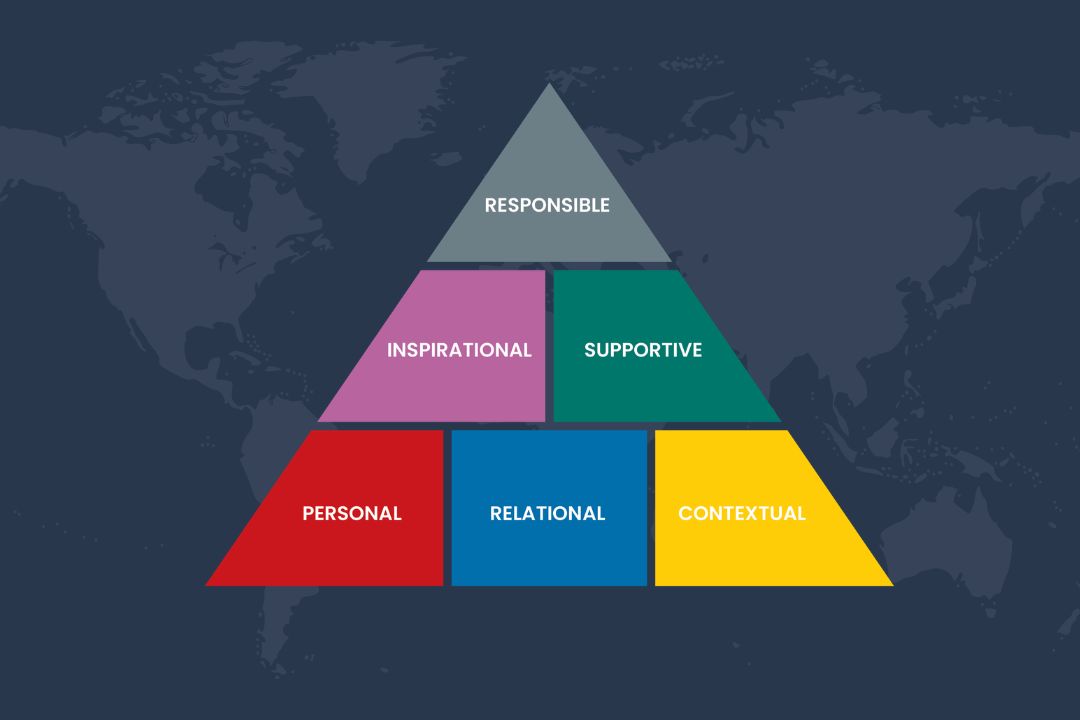
Map the invisible with the Six Domains of Leadership
The patterns described above (misaligned trust, misread silence, lost feedback) are real and costly. They're also difficult to diagnose without structured data. The Six Domains of Leadership Survey, developed by professors Sim Sitkin and Allan Lind at Duke University, provides that structure. Unlike assessments focused primarily on personal strengths, the SDLS captures the full spectrum of leadership behavior across six interconnected domains: personal, relational, contextual, inspirational, supportive, and responsible. For leaders working across cultures, this comprehensiveness is what makes the difference.
The relational and contextual domains surface what others miss
Vandana chose the SDLS specifically because of its relational and contextual dimensions. "Many leadership assessments focus on personal strengths,” she explains, “which is useful for self-awareness, but not always practical when we are trying to understand the intention-versus-impact dynamic that is so important in cross-cultural leadership.
There are certainly other 360° tools that explore leadership impact. However, many tend to focus on corporate leadership benchmarking, exemplary leadership behaviors, managerial effectiveness, or leadership reputation. SDLS is unique because it is not only evidence-based and behavior-focused, but also provides a practical framework for understanding how specific leadership behaviors affect others.”
For cross-cultural leadership, the six domains can be especially powerful because each domain can be mapped against the question: How does this behavior land in different cultural contexts?
- Personal Leadership can help explore how credibility is established across cultures.
- Relational Leadership can be used to examine how trust is built and maintained.
- Contextual Leadership can serve as a mirror to uncover assumptions about roles, authority, communication, and decision-making.
- Inspirational Leadership helps explore what motivates and inspires people in different cultural contexts.
- Supportive Leadership can reveal what empowerment, feedback, and development look like across cultures.
- Responsible Leadership helps examine how leaders demonstrate fairness, ethics, accountability, and stewardship in culturally complex environments.
In this way, the Six Domains of Leadership is not just a tool. It becomes a practical lens for helping global leaders understand how their behaviors are experienced across cultures, and how they can adapt with intention while staying grounded in their values and authenticity.
Group your raters to reveal cultural patterns
One practical strategy Vandana recommends: organize your 360° rater groups by geography or cultural context. When a team in one location rates your contextual leadership highly and a team in another location scores it low, the gap itself becomes valuable data. "You know that you're getting a certain rating by this group located here and a completely different rating from this group located there," she says. "So what is happening here?" That question, grounded in concrete evidence rather than guesswork, opens the door to meaningful coaching conversations and targeted behavior change.
Pair the SDLS with cultural frameworks for deeper insight
The SDLS works powerfully as a standalone tool, and its value deepens when paired with cultural frameworks like Erin Meyer's Culture Map, Hofstede's cultural dimensions, or the Intercultural Development Inventory (IDI). The SDLS shows you where your impact is falling short. Cultural frameworks help explain why. Vandana integrates both in her coaching practice, using the SDLS results to identify the gap and cultural dimensions to illuminate the root cause. This combination gives leaders both the diagnosis and the context they need to adjust their approach with precision.
Put cross-cultural awareness into daily practice
Awareness of cultural dynamics is valuable. Awareness paired with consistent, visible behavior change is what actually shifts team performance and trust. This section translates the insights above into daily leadership practices that compound over time.
Default to more context and more clarity
Vandana's guidance for leaders managing across cultural differences is simple and actionable: "Err on the side of giving more information, making the context much clearer." When cultures differ on how much context is expected, more clarity carries less risk than less. The team that prefers to read the room can easily filter out extra detail. The team that needs explicit steps will struggle, and potentially fail, without it.
This applies to strategic direction, project briefs, feedback conversations, and team expectations. When senior leaders at a global institution brought decision-makers and implementers together to share the reasoning behind strategic choices, alignment followed quickly. The cost of that transparency was an hour of conversation. The cost of withholding it had been months of misalignment and distrust.
Embody your values where it counts
Vandana tells a story from her time heading airport security for a large Indian airport, leading a team of 650 people. When she learned that the lowest-ranking members of her team felt disrespected by officials from another agency, she met behind closed doors with senior counterparts and made the message clear: disrespect toward any member of her team was non-negotiable. By the next morning, the entire team had heard about it.
"Trust can come from many ways," she reflects. "It's what you're embodying." That single act of standing up for her team transformed the working dynamic. People management with 650 team members became "the smoothest sailing" of her career, triggered by one moment of leadership embodiment she hadn't even planned. The lesson: what you do when your team isn't watching often matters more than your formal communication strategy.
Match support to what your team actually needs
Supportive leadership looks different depending on the systems your team members operate within. Vandana points to a concrete example: in India, extended family networks and readily available domestic help historically meant that childcare or elder care rarely surfaced as a workplace concern. In the United States, those support structures don't exist, and leaders who don't account for them lose both trust and productivity.
The principle extends beyond family logistics. Some team members thrive with autonomy; others need regular check-ins to feel supported. Some cultures expect the leader to "have their back" publicly; others value quiet, behind-the-scenes advocacy. The key is asking and then following through. "I trust you. I have your back. I'm there to provide whatever it takes for you to succeed," Vandana summarizes. "And then actually following through."

Lead effectively across cultures with The Six Domains of Leadership Model
Every leader carries cultural assumptions that feel like universal truths. The ones who lead most effectively across boundaries are the ones who can hold those assumptions lightly, listen for what they might be missing, and build teams where everyone's best contribution becomes visible.
Cross-cultural leadership is not about memorizing a list of cultural dos and don'ts. It's about developing the perceptual agility to notice when your impact isn't matching your intention and having the tools and self-awareness to adjust. The Six Domains of Leadership Model provides a structured, evidence-based way to see those gaps clearly, particularly through its relational and contextual dimensions that surface the dynamics most likely to shift across cultural lines.
The gap between intention and impact is real—and it's measurable. If you lead across cultures and want to see where your leadership behaviors land differently than you expect, the Six Domains of Leadership Model & Survey can give you that clarity.
Schedule a consultation with Delta Leadership to explore how the SDLS 360° assessment can strengthen your cross-cultural leadership effectiveness. www.deltaleadership.com
About Vandana Das
Vandana Das is an ICF ACC-certified executive coach, leadership development expert, and Delta Leadership Six Domains of Leadership (SDLS) Certified Coach with over 27 years of global experience across civil service, international development, and small business. Her career spans high-stakes leadership in India's federal services and consulting on inclusive leadership, psychological safety, and culture change for global institutions including the World Bank Group, IFC, and USAID. She holds a master's degree in chemistry, has completed advanced training in Strategic Diversity & Inclusion Management at Georgetown University, and serves as a mentor and advisor across multiple organizations dedicated to sustainable, inclusive leadership. She speaks English, Hindi, Nepali, Maithili, and Bhojpuri.
About Delta Leadership
Delta Leadership is a global coaching and consulting company that helps organizations strengthen leadership effectiveness through the Six Domains of Leadership program. Grounded in more than twenty years of research at Duke University's Fuqua School of Business, the SDLS 360° assessment gives leaders clear, behaviorally anchored feedback on how their actions affect people, teams, and results. Delta's programs are customized to work alongside each client's specific needs, goals, and cultural context, helping leaders across industries and geographies lead with competence, confidence, and clarity.
.svg)
.svg)
.svg)
.svg)


