

.png)
A model that will help you improve your leadership!
Republished with permission from Delta Coach Jose Solera’s Medium Account.
In Medium.com, I have authored many articles about the Six Domains of Leadership (SDL), how it interacts with other models, some specific discussions about some of the domains, how to use it to coach, etc. But, until now, I have not done an overview of the model. So here it is, a brief overview. Note that for more details you should check out the book by professors Sitkin and Lind in Delta Leadership’s website
Professors Alland Lind and Sim Sitkin of Duke University’s Fuqua School of Business developed the Six Domains of Leadership after extensive research in the early 2000s. In their research, they discovered six areas of leadership, with behaviors by the leaders and effects on the followers. These six areas they labeled Domains and the six are: Personal Leadership, Relational Leadership, Contextual Leadership, Inspirational Leadership, Supportive Leadership, and Responsible Leadership. They also realized that some of the domains (Personal, Relational, and Contextual) are basic while Inspirational, Supportive build on them, while the last domain, Responsible, builds on all five of them. Based on this understanding, they show the domains using a pyramid structure.
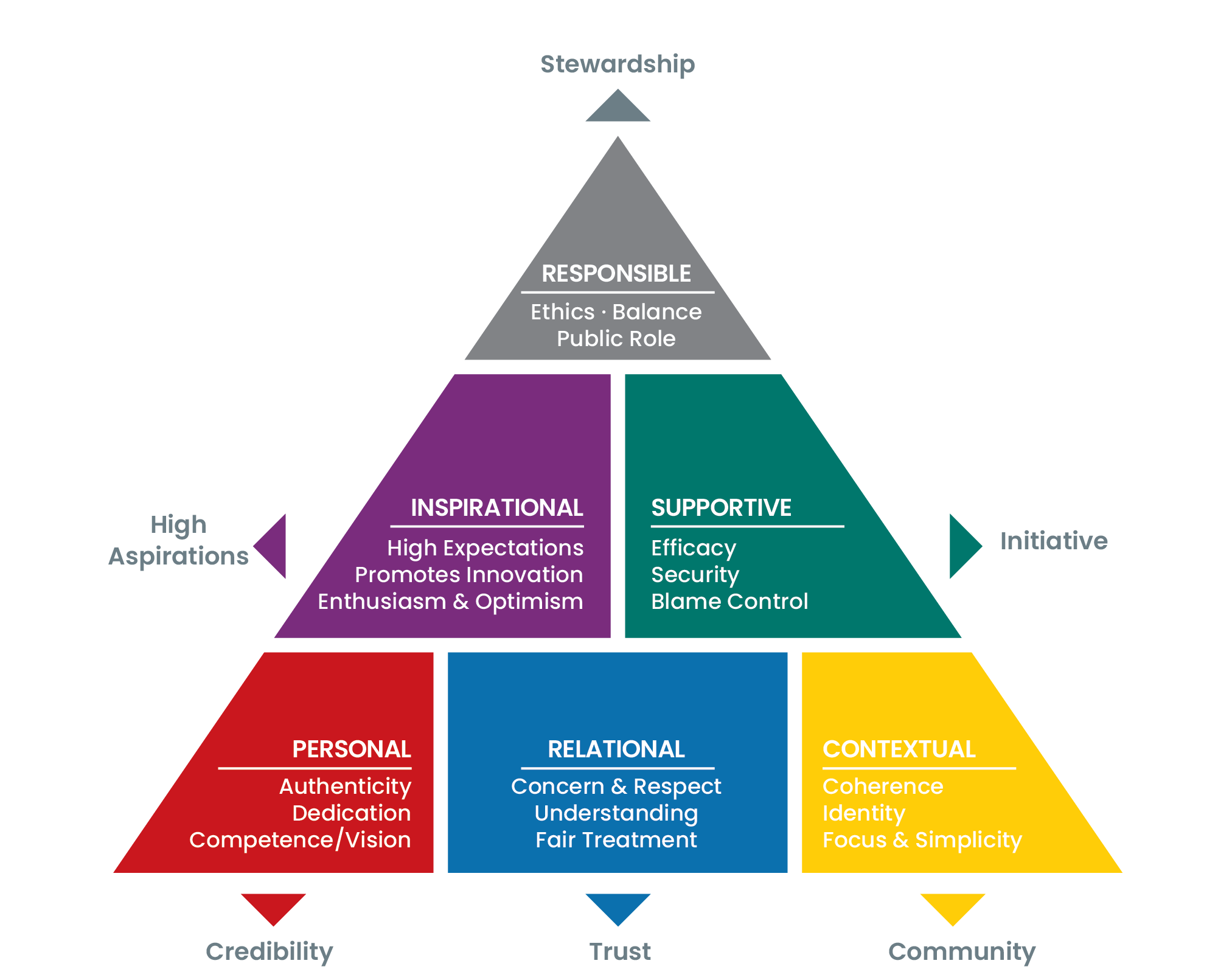
The picture not only shows the structure of the domains, but how they build on the ones below as well as the ones next to each other. It also reflects the leadership effect each domain yields. That is, a leader who shows good Personal Leadership, will be credible. The one that shows good Relational Leadership will enjoy the trust of their team members, and so on with the other domains.
In my experience coaching leaders for over 15 years and driving leadership development efforts before that for another three years at a F100 company, the Six Domains of Leadership model is the simplest yet most complete leadership model with rich in insights on the leader’s leadership. There are other models that complement it, such as Situational Leadership and Tuckman’s Group Development. Yet, SDL is the only one that is complete enough for a leader to use while improving their leadership.
Overview of the Six Domains of Leadership
Personal Leadership
The first domain is Personal Leadership. The pyramid shows it in the lower left corner of the base row. The behaviors in this domain, Vision, Authenticity, and Dedication, make the leader credible in the eyes of the team. Note that this credibility is leadership credibility. Discipline-specific credibility, such as financial or operations credibility, are separate and not addressed by the model.
Vision: the expectation is that the leader will have a vision of what they want the team to do and to be in the future. The leader is also authentic. That is, they are who they are on the surface. And the leader is dedicated. The phrase “leaders don’t ask their followers to do things they would not do themselves” addresses this dedication. If the leader is expecting their team to work extra hours, they will be there with them, even if they cannot contribute directly to the effort. I remember leading the Intel Inside® Program software development effort. We needed a critical report that one of our software engineers had to develop. They had work on a Saturday to get it done on time. I went to the office to be present with them to show support. I could not do the report; I did not have the technical skills, but I felt it was important for me to be there.
Relational Leadership
The second domain, Relational Leadership, sits in the middle of the foundation layer of Personal, Relational, and Contextual leadership. Every domain and effect rests on this domain and its effect of Trust. It is the cornerstone of the model and of leadership. If a leader is not trusted, they will not be (as) effective as if they are trusted.
How does a leader achieve this trust? They show Concern and Respect for their team (and others), they look to Understand the team members and are Fair in their Treatment of the team and others.
One of the things I do as soon as I take over a role is set up one-on-one meetings with each member of the team that reports directly to me, so that we can get to know each other. It is instrumental that they get to know me so that they can eventually trust me. And I need to get to know them so that I know their strengths and that I can trust them.
Also, I organize meetings, preferably face-to-face, so that the team members get to know each other. In the days prior to video conferencing, it was amazing to see how those who were very confrontive of people who they had not met in person, only by phone, changed their attitude once they got to meet the other person face-to-face. The other person was no longer a disembodied voice. They were a human beings. While video meetings minimize this disconnect, they are not the same as meeting in person.
Contextual Leadership
So, a leader is credible and trusted by their team. But unless the team feels a sense of Community there will be issues. A team needs to know how they work with each other (and other teams), what they are good at and what they may need help with. The leader can help in all these areas as well as in explaining what the goal is and how to simplify complex topics. The subdomains are Coherence, Identity, and Focus and Simplify.
As a leader, it has always been instrumental for me to explain what we are trying to do when launching and effort and when welcoming new members. In launching efforts, I invite senior executives to add their voice as to why the effort is so important. In the early days of the Intel Inside Program software development effort, I would walk new team members through the logical data model to give them the context of what they would be working on.
Inspirational Leadership
As a leader, we do not have a monopoly on creativity. We want our team members to aim high; to not wait for detailed instructions. In knowledge-intensive projects, the leader is the one who usually knows the least and encouraging initiative is a way to get the team members to provide even more value. Hence, the leader has High Expectations, shows Enthusiasm and Optimism, and Promotes Innovation so that the team members can have High Aspirations.
Inspirational Leadership rests on top of Personal Leadership and Relational Leadership, so if a leader wants to work on Inspirational Leadership, they should make sure that Personal and Relational Leadership are strong.
As a leader, I encourage my team to have high aspirations. I do this by doing things like empowering and encouraging them to develop their skills. As a new CIO who had to jettison our old client/server technology for cloud-based solutions, I wanted my existing team to take part in this effort. But I knew they needed to develop cloud skills. To encourage this development, I told them how I develop my own skills, told them that I expected them to do the same, and made time for them to be able to do it (this latter part is a behavior for Supportive Leadership, the next domain).
Supportive Leadership
As a leader, we need to make it safe for our team members to take the initiative. As I just said, to get my team to develop their skills, I needed them to have the time to be able to do it. When I joined, they were overworked (60+ in flight projects for about a 12-person team). Not much was getting done. I set up a process to control demand and protected them from my peers’ interference.
To be a good supportive leader, a leader must help show Efficacy, Security, and Blame Control. Understanding what the team can do well (Efficacy), that they are save to try new things (Security), and that whenever things go wrong, and they will, the focus is on what happened and how to prevent it without penalizing them if they did the work in the best possible manner. As Inspirational Leadership rests on Personal Leadership and Relational Leadership, Supportive Leadership rests on Relational Leadership and Contextual Leadership. These two domains should be strengths for the leader as they work to develop their Supportive Leadership.
Responsible Leadership
The pinnacle of the model is Responsible Leadership. This domain is the one where the leader shows Ethical behavior, a good Public Role, and a Balance between short- and long-term requirements or internal vs external requirements. These behaviors yield stewardship not only by the leader, but by the entire team. It rests and builds on the five other domains.
Sometimes as a CIO I had to decide between what the architect and the software engineers wanted. The architect wanted a long-term solution. The software engineers wanted a quick solution. My rule of thumb: whenever possible, I would side with the architect as they have a longer view of the situation, and their recommendations will make things easier in the future. But not always. At times I sided with the software engineers, increasing what is known as “technical debt” (things that eventually the team will have fix) so that we could achieve the goal of the effort.
Six Domains of Leadership Survey and Coaching
A 360° survey is used for leaders and their raters to provide insight into how often a leader shows the desired behaviors. This survey leverages both the numerical response as well as the comments provided by raters to inform the leader and their coach where they are strong and where they should focus their development plans. Experienced coaches use the survey in their conversation, including providing insights into how various domains and subdomains interact with each other.
Six Domains of Leadership Coach Certification Program
The Six Domains of Leadership is an excellent model to help a leader, and their coach, guide leadership development. Are you a coach who would like to learn more about the model and get certified? Join the Six Domains of Leadership Coach Certification Program (CCP) There are multiple cohorts each year. Visit DeltaLeadership for more details.
Not a Coach But Want to Learn and Apply the Six Domains of Leadership?
If you are not a coach but are very interested in learning and applying the Six Domains of Leadership, attend one of Duke Executive Leadership Programs. These are intensive, week-long programs that include the survey and coaching.
Summary
The Six Domains of Leadership is, in my mind, the best leadership model that both leaders and coaches can use in their leadership development journey. You will benefit by learning about it and using it.
.svg)
.svg)
.svg)
.svg)


