


While Change is Hard, and Many Changes Fail, You Can Succeed
Written by Delta coach Jose Solera for Delta Leadership Inc.
“Above all, leading change requires engaging the team in a partnership at all phases.”
Prof. Sim Sitkin and Allan Lind in The Six Domains of Leadership
In a recent Forbes (May 6, 2025) article, “Why Change Management Fails: It’s About People, Not Process,” the author, Cicely Simpson, posits that the biggest reason why change efforts fail is “because employees resist, leaders fail to communicate, and organizations neglect the human element.” She then lists the five parts that make her people-centric approach to change leadership:
1. Clarity: A vision people can rally behind
2. Communication: More than just announcements
3. Commitment: Leaders must model the change
4. Capability: Equipping people for success
5. Culture: Embedding change into the DNA
I agree with Ms. Simpson’s analysis that people are as important, if not more important, than the change process used. Changes most often fail not because of flawed processes but because the leader does not pay enough attention to the people involved and impacted.
Ms. Simpson’s approach complements the change management process you may adopt. A well-defined change management process is important (e.g., Lewin, Kotter). But you must complement it with a people-oriented set of activities.

The Six Domains of Leadership
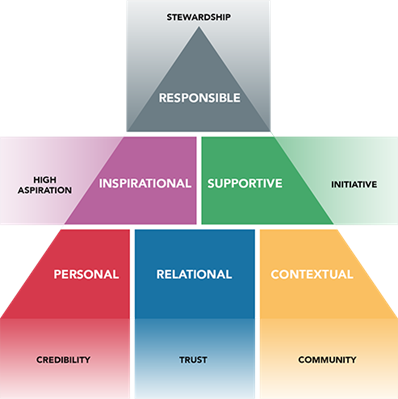
An excellent model to help a leader build these five parts of the change effort is the Six Domains of Leadership (SDL) model. It aligns well with Ms. Simpson’s suggestions. Below is a brief description of the six domains and their relevant impact on Ms. Simpson’s approach. More details can be found at Delta Leadership’s website or in my article “Six Domains of Leadership™ – An Overview”.
1. Personal Leadership – key subdomains are vision and dedication (commitment). Here is where the leader creates and shares the vision of the upcoming change.
2. Relational Leadership – this domain is the crux of the model, the keystone if you will, for all the other domains. It leads to Trust by the followers in the leader and vice versa. While communication is essential in all six domains, it is a must-have to be able to build a relationship with others.
3. Contextual Leadership – leads to a sense of community, of we are all in this effort together. It also helps understand what the team can do well and how it can best work together.
4. Inspirational Leadership – encourages team members to have high aspirations.
5. Supportive Leadership – helps team members feel safe and acquire the skills they need to be successful. Together, Inspirational and Supportive Leadership behaviors help the leader equip their people for success.
6. Responsible Leadership – guides the leader and their team in their efforts to do what is right for the organization, and to embed change into the DNA.
Applying the SDL Model
Now that we have briefly reviewed the SDL model, we can see how a leader can leverage it with Ms. Simpson’s five-part model. Each section includes key actions from the SDL model.
1. Vision
Using Personal Leadership, a leader develops and communicates a vision of what the change entails, how it benefits the organization, and its people. The leader also explains the situation, the place the team members play in the change, and the rationale behind it. In other words, why should team members support the change? This application of Contextual Leadership addresses the need to explain “why” the change must take place.
At the same time, the leader engages with followers to understand their concerns (Relational Leadership) and how to respond to these concerns (Responsible Leadership).
Finally, by sharing this vision, the leader helps the team members imagine the future and their place in it (Inspirational Leadership).
2. Communication
Throughout all leadership actions, the leader leverages their ability to communicate effectively with the team members to, as outlined above, both explain the change and listen to follower concerns, demonstrating concern and respect for their people (Relational Leadership). The leader explains the circumstances that led to the change and the reasons for it. They also explain, to the best of their ability, the potential impacts of the change.
3. Commitment
Leaders demonstrate their commitment to the change through being authentic and dedicated (Personal Leadership). For example, if a leader wants their team to use Artificial Intelligence (AI) responsibly, they must model the way (Personal Leadership). The leader should use AI in their work in a responsible way (Responsible Leadership).
The leader also demonstrates enthusiasm and optimism for the change and the expected outcome. If leaders have this enthusiasm, it makes it easier for the followers to have it too. (Inspirational Leadership).
This commitment by the leader and demonstration of the behavior will help motivate team members and help them feel safe in using AI. (Supportive Leadership).
4. Capability
If the team members do not have the capability to drive and adopt the change, the change will most likely fail. The leader must leverage Supportive Leadership to provide resources, security, and feedback on how well the team members are performing.
The leader must also manage the times when things inevitably go wrong, which are very likely to happen. The goal is to create a culture that leads to learning from mistakes, not punishing people who try to change.To minimize conflict, leaders must define roles and responsibilities (Contextual Leadership). Who is responsible for what? How do team members help each other? Other teams?
5. Culture
For a change to survive long term, it must be embedded in the culture of the organization. The leader continues to demonstrate and exemplify the change. (Responsible Leadership). Team members see that they embody the change, something derived from their sense of community (Contextual Leadership) that the leader has been working to develop.
The leader continues to protect the team (Supportive Leadership) from any opposing forces to the change.
These are only some examples of how the SDL model can help a leader plan and demonstrate behaviors that will help and support the change.
Example
1. Vision
I leveraged my experience in new, more modern approaches to share a vision of a team of software engineers that could deliver value while not working excessive overtime. I also shared the idea of leveraging commercial software rather than building everything from scratch.
2. Communication
I shared this vision with my team and also with the CEO, and my peers. I had to let everyone know the change we were making, why we were making it, and protect the team from outside influences that wanted to go back to the old ways of doing things.
3. Commitment
I shared with my team my personal development program of constant reading, studying, and application of new ideas in my work.
4. Capability
I trained the teams in these new approaches to manage software development, as well as providing them the opportunity to learn and apply new technologies.
5. Culture
We implemented changes gradually and provided value to the organization as soon as possible. I prevented regression (the tendency of an organization to go back to how things were done before) by protecting my team from external demands.
Summary
There are many models for Change Management. Most focus on the process rather than the human side of the effort. Both are key and necessary to succeed in leading a change. We have seen a human side model developed by Ms. Simpson in the article quoted above. We have also seen how the Six Domains of Leadership can support a leader in pursuing Ms. Simpson’s model.
Six Domains of Leadership™ (SDL) References
Throughout this article, I have alluded to some of the domains and subdomains of this outstanding leadership model. If you want to learn more about it and its application, here are some references:
- Visit Delta Leadership’s website, https://staging2.deltaleadership.com. Delta Leadership is the keeper of the SDL model.
- Read my articles in Medium on the SDL model:
- “Six Domains of Leadership™ – An Overview”
- “Leading Project Management”
- Various other articles refer to the Six Domains of Leadership (SDL), how it compares with other models such as Situational Leadership and Tuckman, and leveraging SDL to drive change
- I wrote a series of three articles published on Medium on using the SDL model to drive change, an AI Implementation. The articles use a set of fictional coaching sessions to help the leader implement AI. See
.svg)
.svg)
.svg)
.svg)


