


By: Sim Sitkin
Inspiring teams, setting vision, and building trust are hallmarks of strong leaders. However, many leaders struggle with navigating complexity—the hidden forces, cultural subtleties, and evolving systems that shape organizational dynamics. Contextual leadership, a skill enabling leaders to foster clarity and alignment amidst ambiguity and contradictory expectations, is often overlooked. For coaches and practitioners, developing this area presents a significant chance to empower clients to lead with greater understanding and assurance.
Move from confusion to clarity with contextual leadership
Many leaders possess technical competence and strong interpersonal skills, yet struggle to create clarity amid organizational complexity. The Six Domains Model of Leadership highlights contextual leadership as a foundational, often overlooked capability—the ability to make sense of the environment, communicate meaning, and help teams see their place within the system. When leaders and coaches build this skill, they bridge the gap between confusion and clarity, elevating team performance and organizational health.
This article will unpack why contextual leadership is so frequently underdeveloped, examine the core challenges it addresses, and provide practical coaching strategies for helping clients build this critical skill. By exploring original research, real-world stories, and actionable frameworks, you’ll gain deeper insight into the Six Domains approach—and discover new ways to support clients as they navigate complexity.
Understand The Six Domains of Leadership
Grasping contextual leadership requires stepping back to understand its place within a broader model of influence. The Six Domains framework, which was created through research I did with Allan Lind at Duke University, was born out of a desire to reconcile academic rigor with practical impact, offering a structured lens for evaluating and developing effective leadership.
Clarify the purpose of leadership
Leadership, at its core, is the exercise of direct influence in pursuit of a goal. While management operates through systems and processes, leadership is person-to-person and driven by authentic interaction. This perspective encourages leaders and coaches to look past formal titles and ask: “How are you helping others make sense of your organizational community—and see themselves as part of it?” “Are you actively shaping how others understand, engage with, and feel a sense of ownership of your organization’s mission?”
Our experience across public and private sectors across the world revealed a gap in existing models. We saw that most frameworks were either practical but not rigorous, or rigorous but not easy to use in practice. The Six Domains Model emerged from a drive to marry sound research with day-to-day relevance, focusing on the real challenges leaders face in positively influencing those around them.
Explore the structure of the Six Domains Model
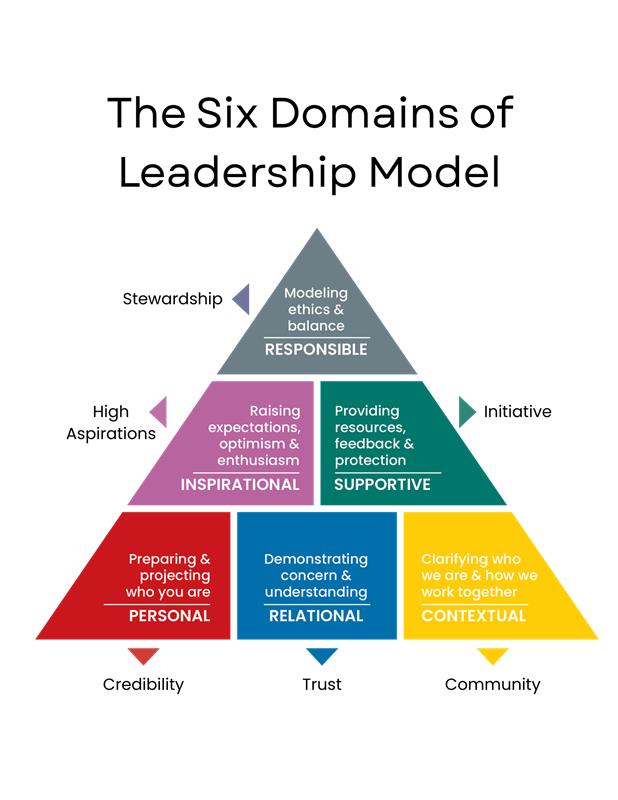
The Six Domains Model divides leadership into six clusters of behaviors, each producing distinct effects. These include personal leadership (effect=credibility), relational leadership (trust), contextual leadership (community), inspirational leadership (aspiration), supportive leadership (initiative), and responsible leadership (stewardship). Together, they form a comprehensive map for understanding how leaders influence individuals, teams and organizations.
What makes the framework unique is its comprehensiveness and its grounding in a broad base of social science research—extending well beyond traditional leadership studies. Drawing from psychology, sociology, and political science, as well as organizational behavior, the model captures the nuanced ways in which leaders shape perception, build meaning, and mobilize action within complex organizational systems.
See the interplay of context, relationships, and outcomes
Contextual leadership sits alongside personal and relational leadership as part of the model’s foundation. Personal leadership focuses on the leader’s credibility; relational leadership centers on building trust and genuine connection with those being led. Contextual leadership, meanwhile, ensures everyone understands the situation—the bigger picture in terms of—the rules, the strategy, and the individual and team roles within the system.
The interplay among these domains means that effective leaders cannot rely on charisma, technical knowledge, or interpersonal skill alone. They must recognize and help others see how their actions fit the broader context, how culture shapes perception, and how situational awareness informs decision-making. This sets the stage for why contextual leadership is so often missing—and why coaches must address it head-on.
Recognize the contextual leadership gap
Despite its importance, contextual leadership is frequently rated as the weakest domain in leaders across industries and cultures. Understanding why this gap exists is the first step in helping clients close it.
Identify why contextual leadership is underdeveloped
The liability of expertise often works against contextual leadership. The more knowledge and experience a leader has, the harder it is for them to imagine what others do not know. Leaders may feel that certain organizational dynamics are self-evident, skipping the work of explanation. Team members, however, often lack the same history or knowledge, and without a clear sense of how their work fits into the larger mission, they disengage.
Organizational silence and fear also contribute to the gap. Some leaders worry that sharing too much information will diminish their power or expose their own gaps in knowledge. Others believe that keeping teams in the dark helps maintain control. In reality, withholding context leaves people confused and less able to contribute meaningfully.
Examine barriers to sensemaking in organizations
Barriers to contextual leadership take many forms. Leaders may avoid explaining decisions due to time constraints or fear of challenging questions. Cultural differences compound the issue: in some settings, conveying credibility or authority requires years of indirect relationship-building, while in others, directness is prized.
Systemic fragmentation is another challenge. In heterogeneous organizations, departments operate with different rules, priorities, and norms. Leaders who fail to articulate how these pieces fit together risk creating silos, undermining both shared identity and operational efficiency.
Pinpoint consequences for teams and performance
The costs of neglecting contextual leadership are substantial. Teams may punch the clock without understanding their importance, feeling disconnected from organizational goals. Misunderstandings fester, productivity drops, and talented individuals disengage. Lack of sense-making erodes the ability to build a shared sense of community—a critical ingredient for collaboration and resilience in diverse, global organizations. Even for those who are positively engaged and competent, a lack of understanding can lead to well-intentioned but misguided actions.
For coaches, addressing these gaps offers a direct path to improving both individual and team outcomes. By guiding clients toward better contextual awareness, you enable them to create clarity, build shared purpose, and reduce the friction that hampers high performance.
Help clients build contextual awareness
Coaches play a pivotal role in helping leaders develop the habits and skills needed for effective contextual leadership. This begins by guiding clients to see beyond their own expertise and adopt a learner’s mindset about their organizational environment.
Guide leaders to see beyond their own expertise
Leaders often assume that what’s obvious to them is equally clear to everyone else. Coaches can disrupt this pattern by asking reflective questions that surface hidden assumptions. When a client describes a strategic decision, invite them to consider: What parts of this story remain untold? Who might need a deeper explanation to fully buy in?
Real progress happens when leaders become conscious of what others don’t know. Stories from diverse industries show that leaders who take time to explain context—even when it seems redundant—build stronger alignment and more motivated teams.
Use coaching to surface systemic blind spots
Coaching conversations can reveal the unseen patterns that shape behavior and decisions. Encourage clients to explore organizational boundaries, cultural norms, and interdepartmental friction. What tacit rules guide your team’s actions? Where do misunderstandings commonly arise? What “liabilities of expertise” might you bring into your role?
By surfacing these blind spots, coaches help leaders articulate the hidden context that governs everyday life. This process not only supports individual growth but also fosters team-wide clarity.
Develop habits for situational learning
Effective contextual leadership is not a one-time fix—it’s a continuous process of sense-making. Coaches can help clients develop simple routines for staying attuned to their environment. Encourage regular check-ins with team members about their understanding of organizational goals and challenges. Suggest practices for reflecting on how changes in market conditions, policies, or team structure affect individual and collaborative daily work.

Apply contextual leadership for clarity and alignment
When leaders embrace contextual leadership, they create shared understanding and alignment even in the most complex settings. Coaches can equip clients with practical strategies for applying this domain in everyday leadership.
Create shared understanding across diverse teams
Diversity in age, experience, function, or geography means that team members approach work with different mental models. Contextual leadership bridges these divides by helping everyone see where they fit into the organization’s mission and strategy.
Different individuals and teams may already have a clear understanding of their own work and situation — but those understandings may differ significantly, and sometimes even conflict. Helping them retain their unique perspectives while also seeing the bigger picture is a central function of contextual leadership.
For example, leaders who regularly explain how the team’s work connects to broader goals foster stronger engagement and a sense of belonging. They also reduce the risk of misalignment or wasted effort. Coaches can help clients practice these communication skills and evaluate their impact over time.
Connect individual roles to the bigger picture
Team members perform best when they understand the significance of their contributions and those of others. Contextual leaders clarify how each role supports organizational objectives, spotlighting the unique value that every individual brings.
In coaching sessions, encourage clients to articulate the “why” behind their requests and the “how” that links actions to results. This helps people move from compliance to commitment, elevating both morale and accountability.
Use context to foster collaboration and resilience
Complex organizations often experience tension between units, departments, or functions. Contextual leadership provides an antidote by building shared language and frameworks for collaboration. When leaders explain why decisions are made, how resources are allocated, and what success looks like, teams can respond with greater trust and flexibility.
Coaches can help clients map key touchpoints where contextual leadership makes a difference, designing interventions that promote open communication and adaptive teamwork.

Tailor contextual leadership to cultural and systemic realities
While the Six Domains Model holds true across cultures, the application of contextual leadership must respect differences in values, power dynamics, and communication norms. Coaches are uniquely positioned to help clients navigate these complexities.
Adapt approaches across global and local settings
Global organizations require leaders to flex their style across cultures. In some contexts, credibility flows from formal position and indirect communication; in others, directness and individual expertise matter most. The key is adaptation—not abandoning the principles of contextual leadership, but tailoring behaviors to fit local expectations. Cross-cultural differences arise not only across national or regional boundaries, but also when leading across professional disciplines, where underlying norms, assumptions, and communication styles can vary just as significantly.
Coaches can guide clients to explore what “making sense” looks like in different settings, using cultural intelligence to inform their leadership practice.
Respect differences in power, hierarchy, and norms
High power-distance cultures may grant authority by virtue of rank, while others demand that leaders earn credibility through performance. Contextual leadership bridges these divides by making the invisible visible: explaining decisions, sharing reasoning, and involving others in sense-making. Adapting to the needs of those one leads is a sign of strong leadership. But how one is adaptive is contingent upon and must be attuned to local cultural norms.
Encourage clients to identify the entry points for contextual leadership in their unique environment. Sometimes this means starting with community and context, then moving to personal and relational leadership. Coaches can help leaders read these signals and adapt their approach accordingly.
Address challenges unique to mid-level leaders
Leading from the middle comes with its own set of pressures. Mid-level leaders often juggle conflicting demands from above and below, navigating transparency and adaptation amid scrutiny from all sides. Contextual leadership is essential in this space, helping leaders explain their rationale, foster understanding, and reconcile incompatible expectations. This applies to ‘leading up” as well as leading direct reports or those outside the leader’s immediate team.
Coaches can support mid-level leaders by helping them develop meta-communication skills: naming the reasons for their choices and inviting feedback when approaches differ across groups. This proactive sensemaking turns adaptation from a liability into a leadership strength.
Conclusion: Allow leaders to navigate complexity with confidence
Contextual leadership is the key to transforming organizational complexity from a source of confusion into a platform for clarity, alignment, and growth. Coaches who help clients master this domain enable them to read the environment, foster community, and build resilient teams.
By understanding the Six Domains framework, identifying barriers to sensemaking, and applying tailored coaching strategies, you can help leaders move beyond technical and relational skill to become true navigators of complexity.
Key Takeaways
- Contextual leadership fills a critical gap in conventional leadership development.
- Many leaders neglect sensemaking, leaving teams confused and disengaged.
- Coaches can help clients surface blind spots and build situational awareness.
- Effective contextual leadership drives clarity, alignment, and collaboration.
- Adapting to culture and hierarchy is essential for global organizations.
- Mid-level leaders especially benefit from proactive contextual leadership.

How will you help a client make sense of their organization’s complexity today?
Every leader faces complexity, but few learn to master it. If you’re ready to help your clients turn confusion into clarity and build lasting alignment in their teams, start by integrating contextual leadership into your coaching toolkit. Encourage reflection, model adaptive communication, and foster a habit of sensemaking. The results will resonate throughout your client’s organization, elevating both their performance and satisfaction.
About the Author
Sim B. Sitkin is the Michael W. Krzyzewski University Distinguished Professor of Leadership, and Professor of Management and Public Policy at Duke University’s Fuqua School of Business and Sanford School of Public Policy. He is Co-founder and President of Delta Leadership, Inc.. and directs the Duke’s Fuqua/Coach K Center on Leadership and Ethics (COLE) and Behavioral Science and Policy Center (BSPC). His research explores leadership, organizational control, trust, and innovation, with work published in top academic journals and several books, including The Six Domains of Leadership. Through Delta Leadership, Sim also advises organizations globally, leveraging his expertise to foster evidence-based strategies for effective management and organizational change.
.svg)
.svg)
.svg)
.svg)


