


It takes work but pays off handsomely!
Republished with permission from Delta Coach Jose Solera’s Medium Account.
People want to be led by a “real” person, someone they can relate to and trust. Someone who has a vision, whose values they are aware of and can agree with. Someone who is dedicated to the effort they are engaging in. How can a leader be such a “real”, “authentic” person? Well, the Six Domains of Leadership™ (SDL) again helps us here. We can use SDL to develop, plan, and execute behaviors that will help us understand ourselves and demonstrate authenticity to those we lead. There’s a link to my “Six Domains of Leadership(TM) — an Overview” at the end of this article.
You may remember that SDL is shown as a pyramid, with Personal, Relational, and Contextual Leadership at the bottom, Inspirational and Supportive Leadership in the middle, and Responsible Leadership at the top. Personal Leadership is located at the bottom left of the pyramid. It is a foundational domain in the model, which means that other domains are supported by it, such as Inspirational and Responsible above, and Relational to the right.

You may also remember that each domain has three subdomains and one leadership effect. The image above shows the leadership effect of each domain. The image below shows a depiction by the author of the subdomains in each domain.
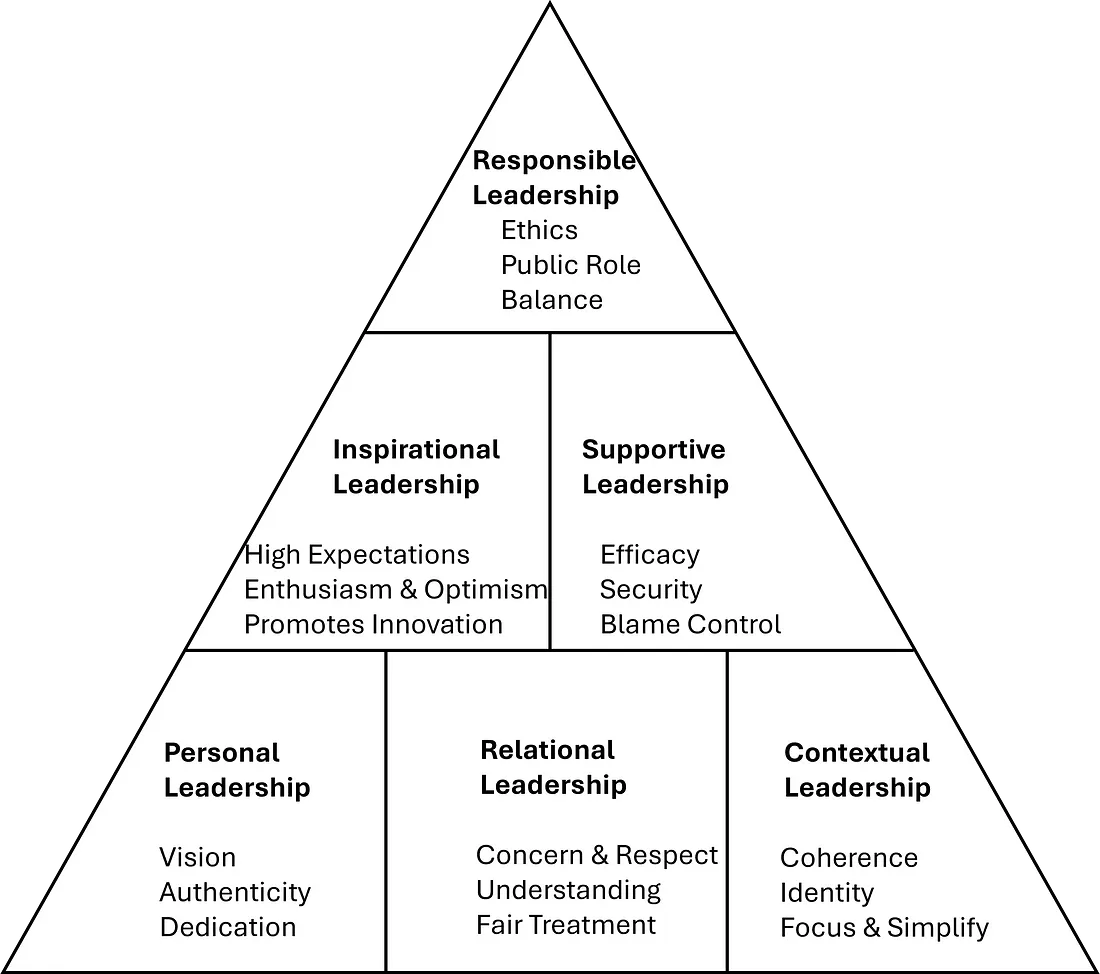
As you can see, one of the subdomains of Personal Leadership is Authenticity. So that subdomain should provide most of the answers as to how a leader should behave to demonstrate authenticity. But there’s more to it than that. A leader needs to know who they are before they can act in a way that is authentic to who they are. And other domains and subdomains can help a leader be and be seen as authentic.
Self-awareness

Self-awareness is critical for a leader to act in a consistent and authentic manner. Leaders have lived their lives having a good sense of who they are and acting accordingly. Still, we can benefit from understanding our values, what makes us tick, etc. Tools such as Myers-Briggs, StrengthsFinder, Clifton Strengths, Wilson Social Styles, etc. are particularly helpful to understand who we are. In this way, we know if we are a Driver, Analytical, Expressive, or Amiable (Wilson Social Styles), Executing, Influencing, Relationship Building, or Strategic Thinking (StrengthsFinder), or some other category which help explain our preferences.
We can also determine our values using various tools, including Delta Value Fit Cards. Reflection and journaling are also useful to help us in this self-analysis.
The Six Domains of Leadership Survey helps us assess which behaviors we demonstrate most commonly, and which ones are most observed by others who rate us, information that helps us understand if our authenticity efforts are coming across to others.
Our Prior Experience and Upbringing
Our prior experience, from growing up to organizations we have worked with, also influences who we are and how we act. It is best if we consciously recognize these influences and how they impact us so that we can leverage them and/or avoid them, as necessary. For example, I worked for Intel for over 20 years. Intel is a very results-focused organization and very confrontive. They even have a class called “Constructive Confrontation” to teach us how to confront appropriately. Focus on the data and outcome, not on the personality of the person, was the guidance. Well, when I transitioned to other organizations, this results-orientation and confrontive style was not welcome, to say the least. I had to adjust my behaviors to the cultural norms of my new organization. So, while I was being authentic to my confrontive behavior, it was not a fit for the current culture, a situation where I had to adjust my behavior and values.
Similarly, our upbringing can have an impact on our values and behaviors. If the leader is brought up in a culture that focuses on family values and respect for those in authority, a competitive culture like Intel’s can be a challenge to adjust to. Understanding that background can help us adjust our behavior and, to some extent, our values to match the current reality. This can be particularly important for those of us who were raised in another culture, such as the Latino culture.
All this information and analysis helps us understand what makes us tick, and what we value, and helps us communicate better with others.
In this way, we understand that if we are focused on results (a Driver in Wilson Social Styles) we still need to work on relating to people. Our awareness prevents us from being the classic bull in the China shop.
Leadership persona
Part of this analysis is developing a leadership persona, a public version of who the leader is, identifying aspects of their personality that align with their leadership values and goals. It is a persona that aligns with the leader’s genuine self, one that incorporates parts of their personality and “fits” them well (be authentic). It highlights strengths while being adaptable. People want to be led by real people, not boxes in an org chart.
It is a leadership persona that leverages the leader’s strengths and values while compensating for weak areas. It is close to the actual person the leader is, but it allows the leader to step up and stretch beyond their comfort level when necessary.
Leverage this leadership persona to take actions that will be seen and interpreted as agreeing with the leader’s values and the values the team members share with them.
See The Six Domains of Leadership eBook for more details.
Authenticity and Others
Like all the six domains and subdomains, authenticity’s value is in how it is demonstrated with and how it impacts others. It is the interaction with those we lead that is important. So, how do we demonstrate authenticity? We do it by
· Being consistent and predictable
· Showing concern and respect, understanding, and fairness
· Being honest about strengths and weaknesses
· Epitomizing fundamental values
· Seeking feedback for self-improvement
Being Consistent and Predictable
A mercurial leader is hard to follow. What they demonstrate today may change tomorrow. Hence consistency in the leader’s behavior is important. The leader must demonstrate their passion and commitment to the organization. This consistency makes the leader’s behavior predictable, so that the team members know what response their leader will have to the members’ actions. It stabilizes what team members can expect from the leader.
Showing Concern & Respect, Understanding, and Fairness
These are the subdomains of Relational leadership, not of Personal Leadership. But this is how the leader demonstrates their authenticity and that the team members can trust them.
Being honest about strengths and weaknesses
A leader must be aware of their own strengths and weaknesses (self-awareness) and acknowledge them, when appropriate, with their team members. This honesty allows the leader and the team members to complement and compensate each other, thereby making the team stronger than if it was just the leader acting.
Related to this honesty is the need for the leader and the team to know and understand their values. The leader should lead by example, determining their own value then working with the team to understand their values and figuring out what adjustments are necessary to ensure smooth performance. The Delta Value Fit Cards are useful in working through this understanding of values.
Epitomizing Fundamental Values
Understanding their values is key for the leader. As stewards of the organization, the leader must also understand and demonstrate organizational values. Understanding their own values and that of their team, the leader can determine what adjustments may be needed, if any. In addition, leaders must act in ways that demonstrate these organizational values, which are part of Responsible Leadership. In this way the leader leads by example.
Seeking Feedback for Improvement
None of us, leaders and team members, are perfect. We show authenticity by asking for and being receptive to feedback on how to improve. In this way not only does the leader improve, but their team members see the leader demonstrating this willingness to improve and that it is part of their authentic behavior.
What do the Leader Gets Out of Being Authentic?
As the discussion above has shown, by being authentic the team members can feel confident in trusting and following the leader. The leader gains credibility, trust, and a sense of stewardship from the team.
By being credible, team members are more willing to follow the leader.
By being trustworthy, the team members are more willing to follow the leader’s guidance, believing that it is in their (team members’) best interest.
By instilling a sense of authenticity, the team members treat the organization as if it was their own.’
This authenticity also creates support for high aspirations by the team members, helping them to meet and exceed their own expectations.
And finally, it creates a sense of community, of “we are all in it together.”
What Should You Do as a Leader?
First assess yourself using one of the tools mentioned above.
Second, determine your values and assess when you are, or are not, demonstrating them.
Third, learn about the Six Domains of Leadership, take its survey, and get some coaching to help you understand the feedback and how to improve.
Result: A Better Team with a Better Leader
By being authentic as a leader, you will help your team improve as you improve. This improvement will yield major results as the team works on to deliver on its commitments. Try it!
More information on the Six Domains of Leadership
If you are interested in mode information on the Six Domains of Leadership, please refer to my article “Six Domains of Leadership(TM) — an Overview”. To get even more information, please refer to the eBook by professors Allan Lind and Sim Sitkin, The Six Domains of Leadership.
Six Domains of Leadership Survey and Coaching
A 360° survey is used for leaders and their raters to provide insight into how often a leader shows the desired behaviors. This survey leverages both the numerical response as well as the comments provided by raters to inform the leader and their coach where they are strong and where they should focus their development plans. Experienced coaches use the survey in their conversation, including providing insights into how various domains and subdomains interact with each other.
Six Domains of Leadership Coach Certification Program
The Six Domains of Leadership is an excellent model to help a leader, and their coach, guide leadership development. Are you a coach who would like to learn more about the model and get certified? Join the Six Domains of Leadership Coach Certification Program (CCP) There are multiple cohorts each year. Visit DeltaLeadership for more details.
.svg)
.svg)
.svg)
.svg)


