It's earned because people can see how you relate to them

Course
With Sim Sitkin
A self-paced course on the behaviors that build trust, from the co-creator of the Six Domains of Leadership model.
32 lessons, 2–3 hours.
Launch price through Cyber Monday, November 30
Trust is a hot topic today. Everyone is talking about its erosion, how to build it, and why groups and individuals distrust each other. But what is it that really leads to trust?
As a leader, you need the trust of the people you're trying to influence before they'll be open to you leading them. And they won't trust you if they don't think you understand or care about them.
Most leaders believe they're trustworthy. Far fewer know how that trust actually gets built, or what quietly erodes it. Building Leadership Trust closes that gap. It gives you a practical, repeatable way to build trust on purpose instead of hoping it happens on its own.
In the Six Domains of Leadership model, trust is the effect of Relational leadership: demonstrating concern and understanding. When it's working, people rely on you and are willing to be vulnerable to your decisions and actions.
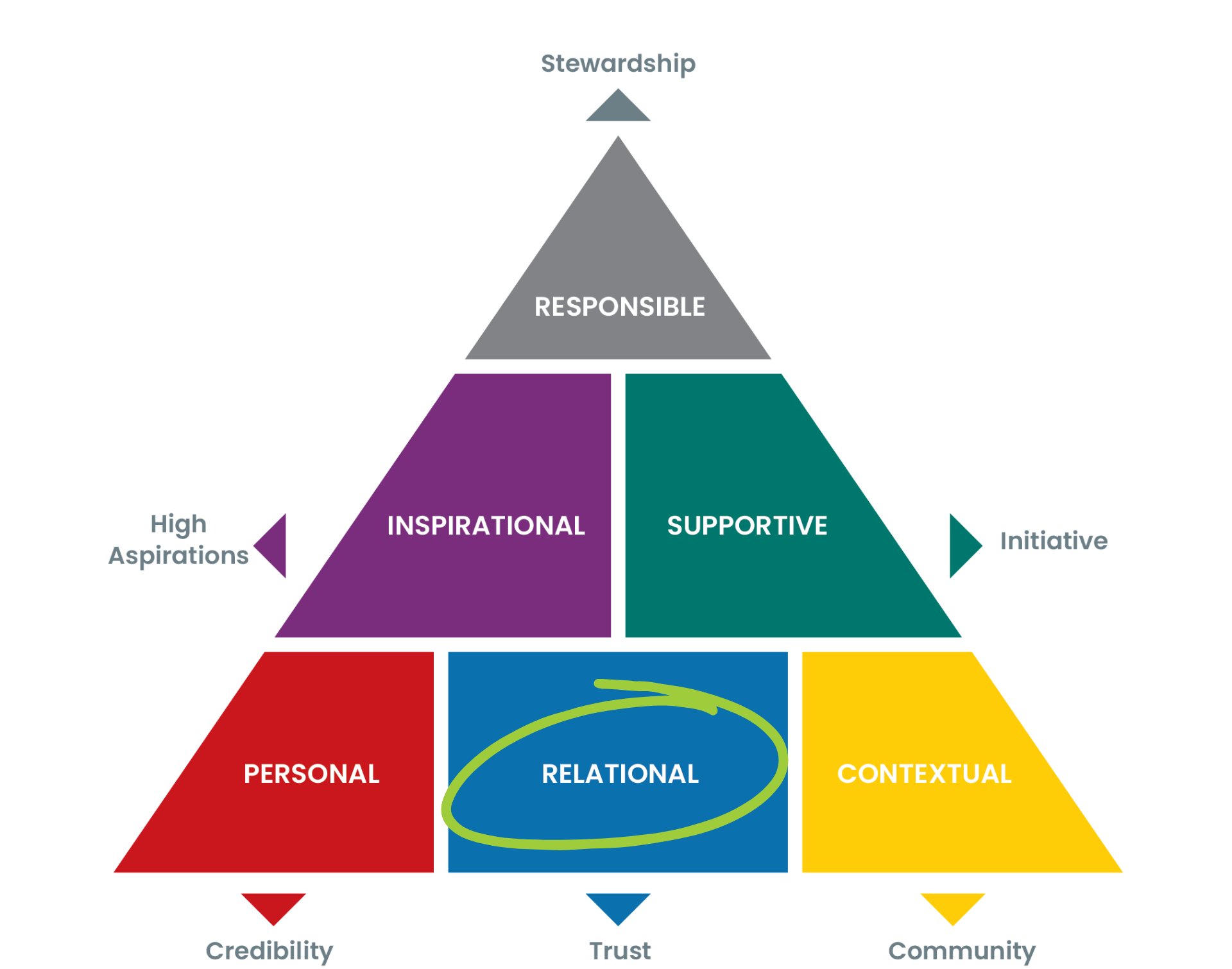
People listen to you because they trust your capabilities and qualities.
People rely upon you and are willing to be vulnerable to your decisions and actions.
Members of the organization feel they are part of a community and not just a collection of individuals.
People on your team consistently try to go beyond the established standards and goals, embracing a sense of challenge and opportunity.
People on your team are willing to take personal initiative when appropriate, and to defer to or involve others when that is more appropriate.
Organizational members take ownership of the mission, live the organization's values, and contribute to its success.
"The Six Domains of Leadership Model gives you specific, research-based results you can incorporate into your behavior to solve the problems you're facing right now."
— SIM SITKIN · DUKE UNIVERSITY · CO-CREATOR OF THE MODEL
Building Leadership Trust (incl. journal: Exploring Your Thoughts and Beliefs)
What Makes People Willing to Rely on You?
How Do You Show People You Care?
How Do You Make People Feel Seen and Valued?
Why Does Fairness Make or Break Trust?
Why Isn’t Meaning Well Enough?
How Do You Build Trust Up, Down, Across and Outside?
What Do You Do When Trust Is Broken?
How Will You Strengthen Trust Starting Now?
How Do You Keep Trust Growing Over Time?
Leaders, managers and rising leaders who want their influence to rest on something more durable than title or tenure, and who are ready to treat trust as a skill, not a personality trait.
Each lesson connects leadership research to recognizable workplace challenges — helping you move from understanding the model to applying it in conversations, decisions, and relationships.
See Fundamentals for LeadersIn Fundamentals for Leaders, expert Sim Sitkin draws on over two decades of research on trust, risk, and organizational behavior to provide a practical executive framework.

His work on leadership and control systems has been applied across top boardrooms and classrooms, from IBM to Duke Medical Center. This course offers a structured approach that enables leaders to evaluate their everyday behavior and pinpoint exactly where to make meaningful changes.
Krzyzewski University Professor of Leadership, Professor of Management and Public Policy, Duke University
Co-Creator · Six Domains of Leadership
Founding Partner · Delta Leadership, Inc.
Director · Duke Behavioral Science & Policy Center
Founding Faculty Director · Duke Center on Leadership and Ethics
Read
less▴
more▾
His research focuses on leadership and control systems and how they shape an organization's capacity for change and innovation. He's widely known for his work on how formal and informal control systems affect risk-taking, accountability, trust, learning from failure, and innovation.
He holds a BA in psychology from Clark University, an EdM in education from Harvard University, and a PhD in business from Stanford University.
Consulting & executive education for: ABB, Alcoa, American Airlines, Cisco Systems, Compaq, Corning, Credit Suisse First Boston, Deutsche Bank, Duke Medical Center, Ericsson, GlaxoSmithKline, IBM, Lenovo, PricewaterhouseCoopers, Red Hat Software, and others.


Completely self-paced. 31 short lessons, roughly two to three hours total, hosted on Thinkific — go at your own pace.
No. Fundamentals for Leaders is the starting point — no prior exposure to the model is needed.
You'll get a clear next step toward The Six Domains of Leadership 360° Survey, and — if you'd like — a path to connect with a coach.
No. It's built for leaders at every level, plus coaches who want a shared framework to use with clients.
That's exactly who Fundamentals for Leaders is built for. The model isn't a personality test or a label — it's a set of behaviors across six domains that can be learned and strengthened, regardless of where you're starting from.
It's built for exactly that constraint. Each lesson is short and self-contained, with a reflection prompt you can act on the same day — you don't need a free weekend to get value from it.
We want you to be confident in your investment in your leadership development. If you're not satisfied with your purchase, you may request a refund within 14 days of purchase, provided that: you have completed less than 20% of the course, you have not received a Certificate of Completion, and you submit your request in writing to info@deltaleadership.com within the 14-day period. Once more than 20% of the course has been accessed or a Certificate of Completion has been issued, the course is considered consumed and is non-refundable. If a refund is approved, it will be credited to your original method of payment within 7–10 business days.
If you experience technical difficulties accessing the course, please contact info@deltaleadership.com. We will work with you to resolve the issue promptly. Technical issues alone are not grounds for a refund if they can be resolved.

Partner with us to strengthen leadership across your organization.